DiffAtOnce: Molecular Diffusion

The FUNPOLYMER project

FUNPOLYMER (PID2021-126445OB-I00) tackles a central question in polymer physics: how to predict molecular weight from diffusion NMR experiments without being limited by solvent choice or sample concentration. Until now, reliable diffusion-based Mw prediction required extremely dilute samples and solvent-specific calibration curves, restricting the practical impact of diffusion NMR outside academic laboratories.

Previous work had shown that the product (diffusion coefficient times viscosity) follows universal scaling laws with molecular weight, but only under very dilute conditions. FUNPOLYMER goes one step further: it shows that the concentration dependence can also be described by a universal scaling law and that, by combining it with the infinite-dilution calibration, it is possible to recover the true molecular weight at any concentration and in any solvent.

The key result is the relation Dη|c = Dη|1/∞ · exp(− κ Cν), where Dη|c is the diffusion–viscosity product at a given concentration, Dη|1/∞ is its value at infinite dilution, C is polymer concentration, κ is a molecular-weight-dependent parameter and ν ≈ 1 for polymers. Together with the scaling laws Dη|1/∞ = a·Mw−b and κ = m·Mw + n, this provides a universal expression that allows Mw to be computed iteratively from any diffusion experiment.

The methodology has been validated for polystyrene (PS) and polypropylene glycol (PPG) in several deuterated solvents (CDCl3, C6D6, toluene-d8 and THF-d8) over a broad concentration range (1.7–150 mg/mL), with Mw errors always below 4 %, covering from a few hundred up to hundreds of thousands of daltons.

In addition, an extensive database of universal calibration curves has been developed, treating viscosity as an independent parameter so that the curves can be applied to a wide variety of polymer systems regardless of the solvent used. Calibration curves are currently available for:

  • Polymethyl methacrylate (PMMA)
  • Unsaturated polyester resins (iso- and orthophthalic)
  • Polyethylene (low- and high-density)
  • Dextran
  • Polyisoprene

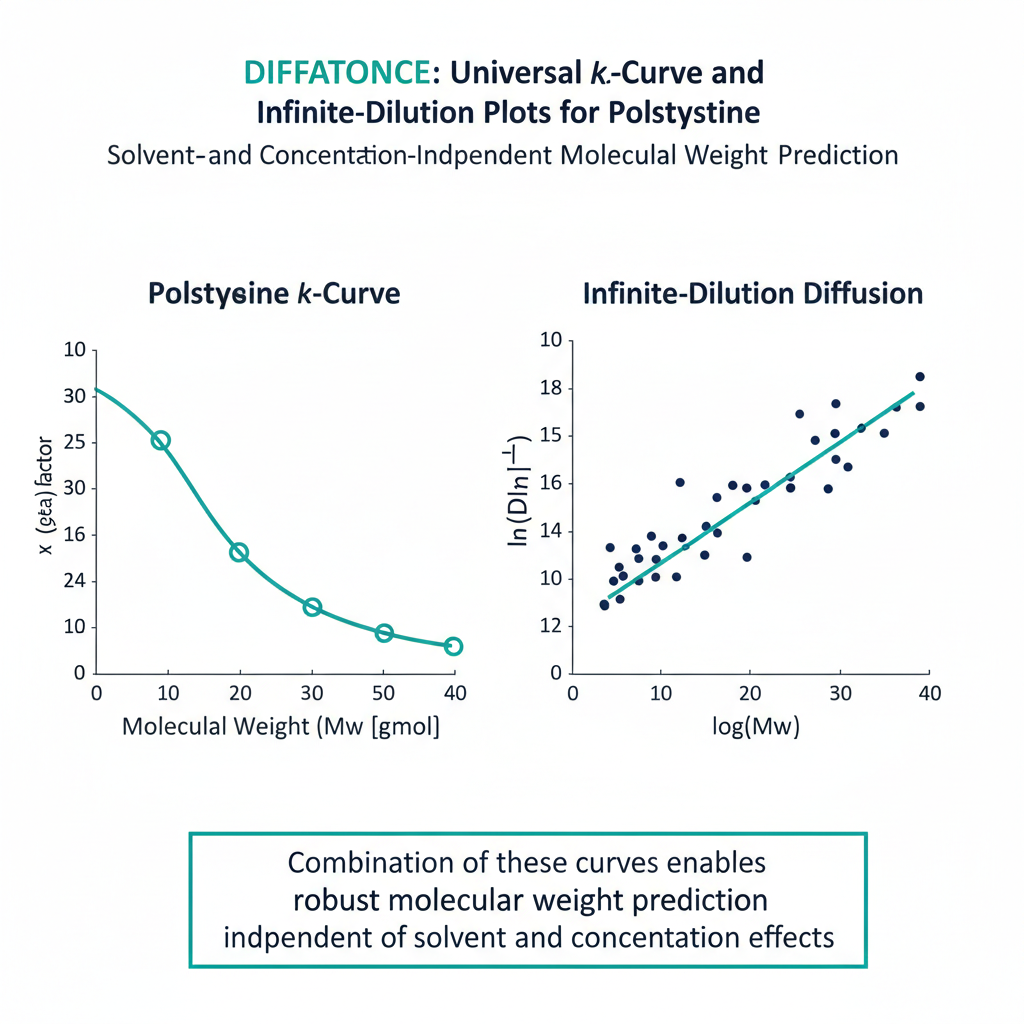
A key achievement of the project is that this database is combined with the innovative methodology for Mw prediction at any concentration and in any solvent, validated through the κ(Mw) and infinite-dilution Dη|1/∞(Mw) curves. In this way, the same infrastructure extends the universal approach well beyond PS and PPG.

DiffAtOnce is the software platform where this physics and mathematical formalism are implemented and made usable in practice.
The core problem

The diffusion coefficient measured by NMR is not only controlled by molecular weight: solvent type, viscosity and polymer concentration also play a major role. In practice this forced measurements close to 1 mg/mL, solvent-specific calibrations and frequent recalibration, limiting the routine use of diffusion NMR for Mw determination.

The new universal solution

FUNPOLYMER shows that both viscosity and concentration dependences can be captured in a single universal scaling law. The equation Dη|c = Dη|1/∞·exp(−κCν) disentangles concentration effects from intrinsic polymer physics, provided κ(Mw) and Dη|1/∞(Mw) curves are available.

Implementation in DiffAtOnce

From a measured D value at concentration C and the solvent viscosity, DiffAtOnce computes Dη|c, applies the new scaling law iteratively and returns the Mw that makes the universal κ and infinite-dilution curves consistent with the experiment, with computation times on the order of milliseconds.

Scientific and technological objectives

Scientific objectives

  • To derive a truly universal scaling law connecting diffusion, viscosity, concentration and molecular weight in polymer solutions.
  • To construct universal κ(Mw) (Kappa curve) and Dη|1/∞(Mw) (infinite-dilution curve) from high-quality diffusion datasets.
  • To interpret dynamic transitions observed in κ(Mw), such as the change of regime around 118 kDa for polystyrene, in terms of chain entanglement and polymer–solvent interactions.

Technological and software objectives

  • To develop a fast iterative Mw solver based on Dη|c, valid for any solvent and concentration.
  • To integrate the universal curves, ILT algorithms and statistical models into DiffAtOnce so that real-world datasets can be processed routinely.
  • To benchmark the methodology against SEC over a wide Mw and concentration range.
Universal κ curve and infinite dilution curve Dη|1/∞ versus Mw
Kappa curve and infinite-dilution curve for polystyrene: κ versus Mw and ln(Dη|1/∞) versus log(Mw). Their combination enables solvent- and concentration-independent molecular weight prediction.

Main methodological lines

All methodological lines in the project converge towards concentration-independent molecular weight prediction:

Diffusion NMR design and acquisition

Optimisation of PGSE, DOSY and extended diffusion sequences to obtain accurate diffusion coefficients over concentrations from 1.7 to 150 mg/mL, avoiding the need to always work in extreme dilution.

Specialized ILT algorithms

Combined use of ILT methods (LMS/DiffAtOnce, TRAIn, dART, SILT-DOSY) to recover diffusion coefficients with typical errors below 3 %, even for complex gradient matrices and noisy data.

Universal κ(Mw) and Dη|1/∞(Mw) curves

Construction of the universal Kappa curve and the infinite-dilution curve from systematic datasets, which form the backbone of the iterative Mw solver.

Iterative Mw method

Algorithm that, starting from an initial Mw guess, repeatedly updates Dη|1/∞ and κ until the difference between measured and calculated Dη|c is minimized, with computation times on the order of 200 ms per sample.

AI and high-performance computing

Integration of machine-learning models and GPU-accelerated computation to explore extensions of the method to more complex distributions and to fast acquisition schemes (UF and time-resolved diffusion NMR).

Validation against SEC

Systematic comparison of diffusion-based Mw values with SEC references, with typical deviations between 1 and 4 %, showing that the new methodology is competitive while offering superior flexibility in solvent and concentration.

Scientific impact

  • First demonstration of a concentration-independent scaling law for determining Mw from diffusion NMR across multiple solvents.
  • Quantitative methodology validated over a wide Mw and concentration range, with errors below 4 %.
  • Embedding of the formalism in a reusable software platform (DiffAtOnce), easing adoption by other research groups and, potentially, industrial users.

Potential applications

  • Molecular weight determination in polymers and biopolymers when SEC is difficult, costly or unreliable (solvent-sensitive systems, complex mixtures, etc.).
  • Development of fast diffusion-based analytical methods, including ultrafast and time-resolved schemes with potential for process monitoring.
  • Future extension to more polydisperse systems and polysaccharides, leveraging the same universal-curve framework.

Basic project information

Acronym:
FUNPOLYMER
Reference:
PID2021-126445OB-I00
Funding body:
Agencia Estatal de Investigación, Spanish Ministry of Science, Innovation and Universities.
Beneficiary institution:
University of Almería.
Estimated duration:
3 years (2022–2025 period).
Responsible research group:
Advanced NMR Methods and Metal-based Catalysts (NMRMBC), University of Almería.
Main software outcome:
DiffAtOnce platform for diffusion NMR analysis and solvent- and concentration-independent Mw prediction.